Video DiT 骨干网络
介绍视频 token、时空注意力、位置编码、条件融合和网络扩展。
前置知识: Transformer、视频表示。
使用步骤: 计算 token 数和注意力成本 → 选择时空交互结构与条件接口 → 分析质量、内存和并行效率。
证据快照:2026-08-30。 本章只采用正式 proceedings、作者论文/技术报告和官方代码或模型页。论文里的速度、显存与质量数字均保留作者协议限定;产品名、演示样例和 README 宣传不能反推出未公开的骨干细节。2026 年预印本、尚未正式发表的系统和只在官方仓库出现的实现会明确标注。
一句话先说清:Video DiT 是把带噪视频表示、噪声/运输时间和条件映射为预测目标的网络骨干;它不是 tokenizer,不是 diffusion/flow objective,也不自动等于少步、流式或实时。
本章回答六个容易混在一起的问题:
- 一段视频到底会变成多少个 backbone token?
- full、factorized、window、sparse、linear、recurrent 和 hybrid attention 分别改变了什么连边?
- 文本、时间步、图像、音频和控制条件在哪里进入 block?
- 3D 位置编码、frame packing、FPS 与宽高比条件为什么会决定网格外推?
- depth/width、noise-time MoE、并行、量化、缓存和减少采样步数分别改变哪一笔成本?
- 怎样做公平且可证伪的 backbone 比较,而不是把 tokenizer、数据、objective 或硬件收益错记到架构头上?
1. 范围与术语
令视频 tokenizer 输出连续 latent:
在噪声或运输时间 \(\tau\) 上,骨干实现的是某个条件映射:
其中 \(c\) 是文本、图像、音频、相机或其他条件,\(m\) 是可选的 attention mask,\(\widehat y_\tau\) 可以是 \(\epsilon\)、\(x_0\)、score、常见 \(v\)、flow velocity 或蒸馏目标。输出头预测什么由 objective 决定;内部怎样混合 token 才由 backbone 决定。
| 相邻层 | 它负责什么 | 本章只接收什么接口 | 不能从 backbone 推出的结论 |
|---|---|---|---|
| 视频 Tokenizer | pixel 与连续/离散表示、压缩、重建和 causal codec | latent shape、通道、时间/空间压缩与边界约定 | patch 数少不等于真实 bitrate 低;骨干也不能恢复 tokenizer 已删除的信息 |
| Diffusion / Flow 与 Consistency | 概率路径、训练 target、solver/sampler、NFE | \(z_\tau\)、\(\tau\)、target type 与 loss weighting | DiT 不等于 diffusion;flow Transformer 也不是一种新 attention |
| Factorization | full-sequence、AR、masked、hierarchy 或 causal chunk | 数据时间 \(k\) 上谁能读取谁 | causal attention 不自动证明可持续 commit |
| 本章:Backbone | patch、位置、mixer、条件融合、FFN/MoE、路由与执行图 | 给定输入和目标后的网络实现 | 参数更多、attention FLOPs 更少或 GPU 更多都不自动等于更好/更快 |
| 因果、流式与实时 | history exposure、lookahead、revision、commit、backpressure 与 SLO | 骨干的实际 mask、cache 和状态更新规则 | causal mask 不自动推出 TTFF、p99、jitter 或 deadline 达标 |
2. 计算组成
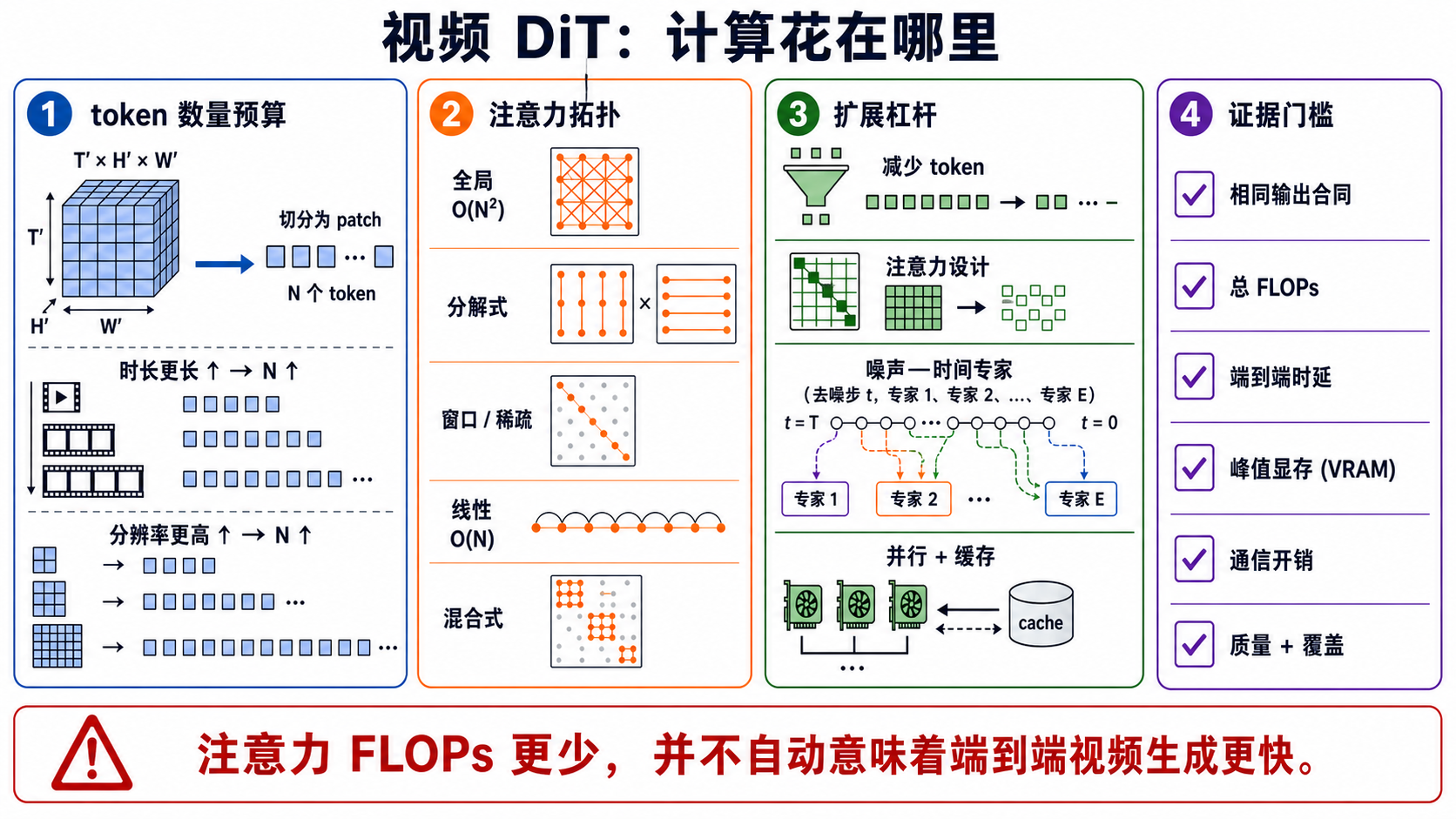
图 1:先记 token 账,再讨论“高效”。 原始教学图,不复刻任何论文结构图。Attention topology 决定 token 之间怎样通信;token reduction、noise-time experts、distributed parallelism、denoising-step reduction 和 caching 不能互换。底部警告是本章最重要的工程边界:attention FLOPs 下降,不保证端到端视频生成更快。生成提示词、SHA-256、来源边界和视觉验收见研究记录。
2.1 Token 预算
若在 latent 网格上使用 patch size \((p_t,p_h,p_w)\),序列长度是:
这条式子把三个常被混用的词拆开:
- tokenizer compression 决定 \(T',H',W',C_z\);
- patchification 决定每个 backbone token 覆盖多少 latent cell;
- attention topology 决定这些 token 之间建立多少连边。
例如把视频时长翻倍、其余不变,\(N\) 近似翻倍;dense global attention 的 score matrix 元素数则近似变为四倍。若同时把高和宽各翻倍,\(N\) 近似变为四倍,dense score matrix 近似变为十六倍。这里尚未计入文本 token、padding、frame packing、多个条件流和 CFG 的额外前向。
2.2 不能只报 attention 的 \(O(N^2)\)
对单层 dense self-attention,若 hidden width 为 \(d\),head 数为 \(h\),粗略主项包括:
因此“attention 是二次复杂度”只描述 global dense attention 的一部分。在较短序列或很宽的模型上,\(Nd^2\) 投影与 FFN 仍可能占主要时间;在多卡长序列上,all-to-all、all-gather 和 kernel launch 可能主导 wall time。一个可信的效率结论必须同时报告:
3. Video DiT 模块
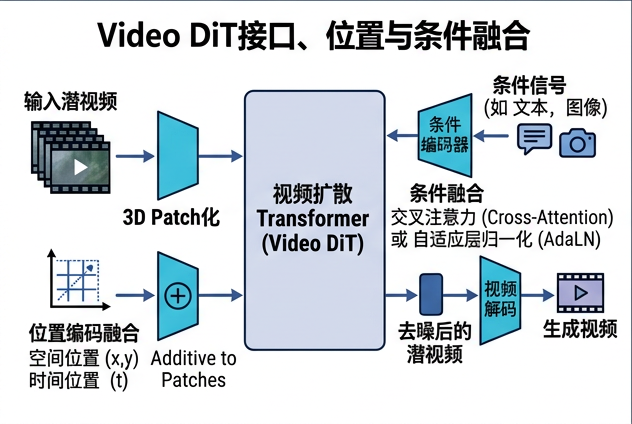 图 2:同一个 block 可以承载不同 objective。 顺序化文字替代:pixel video 先由 codec 变成 latent grid;patch embedding 加入时空、FPS 和 modality 位置后成为 \(N\) 个视频 token。噪声时间可以经 AdaLN/FiLM 调制 block,文本、图像、音频或控制可经 cross-attention 或 joint/dual stream 融合。时空 mixer 与 FFN/experts 重复 \(L\) 层,输出再 unpatchify;最终预测 \(\epsilon\)、\(x_0\)、score、\(v\) 还是 flow velocity 由 objective 决定,solver/NFE 属于采样层。
3.1 Mixer、FFN 与 residual 是三笔不同计算
标准 Transformer block 可抽象为:
其中 \(M_\ell\) 是 attention/linear mixer,\(F_\ell\) 是 FFN 或 MoE。替换 mixer 不会自动减少 FFN 成本;路由 FFN 专家也不会自动改变 attention 连边。实现报告至少要拆出 mixer、FFN、condition modules 和 output head 的参数与耗时。
3.2 两个时间坐标不能混
- \(k\):视频数据时间,对应第几帧/latent slice;causal、bidirectional、window 和 temporal RoPE 都约束这一轴。
- \(\tau\):diffusion/flow 的噪声或运输时间,对应第几次 denoiser 调用;AdaLN 的 timestep conditioning、noise-time MoE 和 inter-step cache 约束这一轴。
Wan2.2 的高噪声/低噪声 expert 是沿 \(\tau\) 路由,不是把视频前半段交给一个 expert、后半段交给另一个。相反,causal temporal attention 限制的是 \(k\) 上能否读取未来帧。把两者都叫“temporal routing”会产生根本性误读。
4. 时空注意力结构
设每个时间位置有 \(S=H_pW_p\) 个空间 token,总长度 \(N=T_pS\)。
4.1 Full spatiotemporal attention
所有视频 token 在一层中两两交互,attention 主项为:
优点是单层 receptive field 全局,便于远距离身份、场景与事件通信;缺点是 score matrix 随时长和分辨率平方增长。Step-Video-T2V 的技术报告明确采用 3D full attention,HunyuanVideo 的双流到单流 block 也在统一 token 序列上做全注意力;这些设计证明“大模型可以采用 full attention”,却不能证明 full attention 在固定预算下总是最佳 [8] [9]。
4.2 Factorized / axial space–time attention
先在每个时间切片内做空间 attention,再让同一空间位置跨时间交互,主项近似:
相对 full attention,它删除了一层内任意时空位置的直接连边;多层交替后仍可传播到全局。Latte 系统比较了四种时空分解变体;早期 video diffusion 与大量图像模型视频化方法也常把 spatial 与 temporal block 分开 [2] [5]。公平比较必须匹配层数、宽度和计算,否则“分解更好”可能只是更深网络或更强图像初始化的收益。
4.3 Window / local / shifted attention
每个 query 只读大小为 \(w\) 的局部窗口,attention 主项近似 \(O(Nwd)\)。W.A.L.T. 将 spatial window 与 spatiotemporal window 组合,用局部连边控制成本 [3]。窗口化的真实问题不是“能不能生成”,而是:
- 跨窗口信息要经过多少层、shift 或 global token 才能相遇?
- 快速主体跨越窗口边界时会不会出现身份、纹理或轨迹断裂?
- padding、非方形宽高比和可变帧数下,窗口覆盖是否改变?
4.4 Dynamic sparse / block sparse attention
若每个 query 实际保留 \(k\ll N\) 个 key,attention 乘法可降到约 \(O(Nkd)\)。但只有在候选选择、mask 构造和 sparse kernel 也避免生成完整 \(N\times N\) score 时,端到端复杂度才真正下降。否则只是先花 \(O(N^2)\) 找稀疏模式,再少做一部分 \(AV\)。
RAPID 复用早期 denoising step 得到的 attention importance,并跨 step 调整稀疏密度;DSA、AdaCluster、VMoBA 和 VecAttention 则从 distributed sparse attention、query-key clustering、mixture-of-block 与 vector-wise sparsity 等方向改变稀疏选择 [20] [22] [23] [24]。这些方法的共同验收点是:实际 kernel density、selector overhead、通信量和质量非劣界,不能只报理论 \(k/N\)。
4.5 Linear / recurrent attention
线性 attention 通常利用特征映射或结合律,把
替换为可先聚合 \(K,V\) 状态的形式。其复杂度可能写成 \(O(Nrd)\) 或 \(O(Nd^2)\),取决于 feature rank、head width 和 kernel;“linear”描述对序列长度的渐近关系,不表示常数小,也不保证有限精度下与 softmax 等价。
LinGen 以线性复杂度架构面向高分辨率分钟级视频;SANA-Video 用 block-wise linear DiT 和 cumulative KV state;ReHyAt 用 recurrent hybrid attention 将局部 dense 交互与可传递状态结合 [12] [15] [26]。这条路线最需要验证的是:长距、小物体重现、属性绑定和快速运动是否被低秩/压缩状态抹掉。
4.6 Hybrid attention
Hybrid block 在部分层、head、token 或 chunk 上保留 dense softmax,其余走 linear/sparse 路径。若 dense 比例为 \(\alpha\),粗略账本应写成:
SANA-Video 2.0 的公开设计是 75% gated bidirectional linear attention 与 25% dense softmax anchor,并加入跨网络深度复用 completed-block feature 的 AttnRes;官方文档截至本章快照日公开的是 5B 720p checkpoint,而 14B 配置/权重仍标为 coming soon [16] [17]。因为四分之一层仍是 dense softmax,这一固定比例架构的严格渐近复杂度仍含 \(O(N^2)\) 项;“以线性层为主”不能缩写成“整个模型严格 \(O(N)\)”。Attention Surgery、BLADE 与 ReHyAt 分别从 post-training linearization、block-sparse + step distillation 和 recurrent hybrid 方向说明:2026 年的前沿不再只是“把 softmax 全部换掉”,而是学习哪些位置仍值得保留昂贵交互 [25]–[27]。
4.7 Causal / bidirectional / lookahead 是 mask 轴
Mask 与 mixer 类型正交:dense、window、sparse、linear 或 hybrid 都可以是双向、严格 causal 或有限 lookahead。对视频数据时间 \(k\):
其中 \(\ell=0\) 是严格 causal,\(\ell\gt0\) 是有限 lookahead。这个 mask 只定义信息可见性;要声称 streaming,还必须给出 chunk 输入、state/cache 更新、revision window、commit frontier、backpressure 和真实 SLO。
5. 位置编码与条件融合
5.1 时空位置编码
视频 token 至少有 \((k,h,w)\) 三个几何坐标,还可能需要:
- 实际 FPS 或 frame interval,区分“相同帧数但不同物理时长”;
- 原始宽高比与 resize/crop/pad 元数据;
- 文本、视频、音频、reference 等 modality/type;
- chunk offset、camera/view 与噪声时间 \(\tau\)。
3D RoPE 把旋转位置编码分配到时间、高和宽维;它能让 attention score 感知相对坐标,但不会自动解决训练网格外的频率外推。Open-Sora 报告 temporal RoPE 与可变尺寸 conditioning,CogVideoX 使用 frame packing 训练多分辨率视频,SANA-Video 2.0 官方文档写明沿用 Wan 风格 3D RoPE [7] [11] [17] [30]。必须分别测试:训练外帧数、FPS、宽高比、padding offset 和 mixed-image/video batch。
5.2 三类常见条件入口
| 条件入口 | 机制 | 强项 | 典型风险 |
|---|---|---|---|
| Cross-attention | 视频 query 读取文本/参考条件的 key/value | 条件和视频流分开,易插拔 | 条件只在少数层进入,细粒度绑定可能弱 |
| AdaLN / FiLM / gating | 由 \(\tau\)、文本池化或其他条件生成 scale/shift/gate | 低额外 token 成本,适合全层调制 | 池化会压缩词级关系;gate 饱和会让条件失效 |
| Joint / dual-stream tokens | 条件 token 与视频 token 分流后合流,或在同一 self-attention 中交互 | 双向细粒度通信 | 序列更长、condition leakage 与模态不平衡 |
图像 Stable Diffusion 3 的 MMDiT 使用文本与图像各自权重并允许双向信息流,是后来多模态双流/合流设计的重要架构祖先;它本身不是视频时序证据 [4]。CogVideoX 的 expert transformer 为文本与视频使用 expert adaptive LayerNorm;HunyuanVideo 则采用双流后接单流的结构 [7] [8]。比较融合方式时,应做条件交换、条件删除、局部控制和非目标泄漏测试,而不是只看平均 prompt score。
6. 模型扩展
6.1 减少 token:改变 \(N\)
更强 tokenizer 压缩、更大 patch、pyramid、token merge/prune 都能减少 \(N\)。它们最直接地降低后续每层成本,却可能删掉文字、小物体、快速运动与视差。LTX-Video 把高时空压缩和全时空 attention 组合起来,说明“能用 full attention”有时来自前置 token 预算,而不是 attention 本身突然廉价 [10]。报告必须同时给出 codec reconstruction ceiling,不能把 generator 的模糊归罪于 backbone,也不能把生成式 decoder 的锐利幻觉算成忠实恢复。
6.2 Depth / width:改变每 token 容量
DiT 的图像实验建立了随模型 GFLOPs 增长而改善的 scaling 观察 [1]。视频上还要同时扩展时空 token、数据质量和并行系统,因此不能从图像 scaling curve 外推“参数翻倍必然改善运动”。至少报告 \(L,d,h,d_{ff}\)、训练 token/样本数、每样本网格与总训练 FLOPs。
6.3 Noise-time MoE:改变 total 与 active parameters
Wan2.2 官方实现沿 denoising timestep 切换 high-noise 与 low-noise expert:前者负责高噪声阶段的整体布局,后者负责低噪声阶段的细节;官方仓库将其描述为约 27B 总参数、每个 denoising step 激活约 14B [18] [19]。正确账本是:
但这不表示每个 active expert 内部 attention 已变便宜。还要报告两个 expert 是否同时常驻显存、是否 CPU/offload、切换开销、每个 \(\tau\) 区间的利用率,以及切换边界是否产生质量不连续。若路由只由预定 timestep 阈值决定,也不能写成 content-adaptive MoE。
6.4 分布式并行:改变 wall time 与每卡内存,不删除总工作
| 并行轴 | 常见切分 | 主要通信 | 关键边界 |
|---|---|---|---|
| Data parallel / FSDP | batch、参数/梯度/optimizer state | all-reduce / all-gather | 不扩大单样本 attention context;训练与推理作用不同 |
| Tensor parallel | head、channel、FFN | 每层 collective | 小 batch 或慢互连时通信占比高 |
| Sequence/context parallel | 时间/空间 token | attention 所需 K/V 或 partial result 交换 | 能容纳长视频,但 total FLOPs 未消失 |
| Pipeline / PipeFusion | layer、patch 或 denoising stage | stage activation、bubble/stale context | micro-batch、调度与近似上下文改变延迟 |
| CFG parallel | conditional/unconditional branch | 末端合并 | 只在启用 CFG 时有对应工作可并行 |
ScaleFusion 针对视频 DiT 的时空 attention 做分布式切分与通信重叠;xDiT 组合 sequence parallel、PipeFusion 与 CFG parallel [29] [31]。论文中的强扩展数字只能在给定模型、GPU 数、互连、序列、batch 和精度下成立。应同时报告单卡不可运行时的 scale-up capacity 与固定问题规模下的 strong scaling efficiency。
6.5 生成迭代缓存与视频 KV 缓存
同一采样轨迹中,相邻 denoising step 的 activation/attention 常相似,因而可复用:
- PAB 按不同 block 的差异曲线广播旧 attention 输出,并结合 broadcast sequence parallel [13];
- AdaCache 根据内容与运动变化自适应决定 cache schedule [14];
- FasterCache 复用条件/无条件等特征,属于作者预印本路线 [28];
- RAPID 复用的是 attention sparsity/importance,并随 step 自适应改变密度 [20]。
它们与 causal AR 的 data-time KV cache 不同:后者复用历史 frame/token 的 \(K,V\);inter-step cache 复用同一个 noisy sample 在相邻 \(\tau\) 的中间量。若声称“精确 cache”,应在相同 seed 下与 full recompute 做数值容差比较;若是近似 cache,则必须按高/低噪声、运动速度、scene cut、prompt/control 改变和多样性分层报告误差。
6.6 量化与减少 NFE:另两条执行轴
ViDiT-Q、QuantSparse 和 DeltaQuant 分别探索视频 DiT 量化、量化与稀疏协同、时空 delta smoothing [32] [33] [34]。量化改变算术精度、权重/activation bytes 和 kernel;减少 NFE 则减少 backbone 被调用的次数。完整方法谱系与校准、低比特 kernel 的证据边界见视频扩散量化综述。端到端成本近似:
这里 \(\rho_i\) 是第 \(i\) 步实际 attention density,\(q_i\) 是精度。把一个 4-step sparse/quantized 系统与 50-step dense FP16 baseline 比较可以说明“整套系统更快”,却不能单独归因于 attention、quantization 或 distillation。
以上仅分析 backbone 内部的执行成本。若需继续比较少步蒸馏、参数/结构剪枝、token pruning、低比特量化、跨步 cache、底层算子、显存调度和多卡在线服务的端到端组合,见推理加速综述导航;按瓶颈可直接进入蒸馏、量化、模型剪枝、Token/注意力稀疏、缓存与复用或底层算子、并行与在线服务综述。
7. 代表工作
| 首次公开 → 正式状态 | 机制节点 | 它真正推进了什么 | 证据边界 |
|---|---|---|---|
| 2022-12 → ICCV 2023 | DiT [1] | 把 latent patch Transformer 作为 diffusion backbone,并做图像尺度化实验 | 图像结果不证明视频时序;“DiT”不指定视频 attention topology |
| 2023-12 → ECCV 2024 | W.A.L.T. [3] | 共享图像/视频 latent;空间与时空 window attention | 局部窗口不是全局 dense;三级生成系统的收益不能只归因于 backbone |
| 2024-01 → TMLR 2025 | Latte [5] | 系统比较四种 factorized Video DiT 变体 | 论文配置与数据规模不代表所有大模型排序 |
| 2024-02 → 技术报告 | Sora report [6] | compressed latent 上的 spacetime patch Transformer,支持多时长/分辨率/宽高比 | 未公开完整 block、参数、训练或 sampler;不能据演示补全架构 |
| 2024-03 → ICML 2024 | Stable Diffusion 3 / MMDiT [4] | separate modality weights 与 joint bidirectional fusion | 图像多模态架构祖先,不是视频运动实验 |
| 2024-08 → ICLR 2025 | CogVideoX [7] | 3D VAE、expert adaptive LayerNorm、frame packing 与开放视频 DiT | “expert”指模态专用归一化/路径,不能和 timestep MoE 混称 |
| 2024-12 → 作者报告/开放实现 | HunyuanVideo [8] | >13B dual-stream→single-stream full-attention flow Transformer | 作者人评和工程报告需独立复现;模型家族/版本不可混用 |
| 2024-12 → 作者预印本/开放实现 | LTX-Video [10] | 高压缩 latent + full spatiotemporal attention 的实时取向 | H100 上作者速度受分辨率、时长、步数和精度限定 |
| 2025-02 → 作者技术报告 | Step-Video-T2V [9] | 30B、3D full-attention DiT、204-frame 系统报告 | 系统结果同时来自 VAE、数据、objective、DPO 与并行,不是纯 backbone ablation |
| 2025 → CVPR 2025 | LinGen [12] | 线性复杂度长视频生成路线 | “分钟级”是作者协议;质量与长距覆盖仍需匹配实验 |
| 2025 → ICLR 2025 | PAB [13] | 跨 denoising step 的 attention output broadcast/cache | 最高加速是特定模型/任务协议,不是精确等价 |
| 2025 → ICCV 2025 | AdaCache [14] | 内容/运动感知的自适应 cache schedule | 需分层检查高速运动与 scene cut,而非只报平均加速 |
| 2025 → MLSys 2025 | ScaleFusion [29] | 分布式视频 attention 与通信重叠 | 多卡速度不等于总 FLOPs 降低 |
| 2025-07 官方仓库/权重 | Wan2.2 [18] [19] | high/low-noise 两 expert 按 \(\tau\) 阈值切换 | 未核验到 Wan2.2 独立正式论文;仓库 citation 仍指基础 Wan 报告,不是 content-adaptive token MoE |
| 2025 → ICLR 2026 | SANA-Video [15] | block linear DiT 与 cumulative KV state | 一分钟/720p、训练成本与速度均为作者协议 |
| 2026-07 → 预印本/部分开放 | SANA-Video 2.0 [16] [17] | 3:1 linear/softmax hybrid、AttnRes、5B/14B 设计 | 快照日仅 5B checkpoint 可核验;不能把 14B “coming soon”写成已发布 |
| 2026 → CVPR 2026 | LinVideo [21] | 以 post-training 把既有视频 DiT 选择性转为线性 attention | 作者 1.43–1.71×、配合 4-step 15.9–20.9× 是具体协议,不是所有 checkpoint 通则 |
| 2026 → CVPR 2026 | RAPID / TimeRipples [20] [35] | RAPID 跨 denoising step 复用 sparse mask/score;TimeRipples 在同一次 attention 内复用相邻时空 latent 的部分计算 | 后者论文速度含 attention saving 的比例估算,不能冒充已由结构化 kernel 端到端实测 |
| 2026 → ICLR/CVPR 2026 | DSA、BLADE、Attention Surgery、ReHyAt [22] [25]–[27] | distributed sparse、稀疏+蒸馏、linearization 与 recurrent hybrid | kernel、训练/微调预算、NFE 和硬件必须分别报告 |
这里的时间按“首次可核验公开材料 → 正式 venue”写,不用正式发表年份倒置技术先后。预印本或官方仓库节点不被冒充为同行评审结论。
8. 方法比较
8.1 全局、分解与窗口注意力的通信范围
问题。 视频既需要邻近运动连续,也需要远距离身份与场景状态。全局连边昂贵,局部连边又可能让信息传播路径过长。
三种代表回答。 W.A.L.T. 用空间/时空窗口控制直接邻域;Latte 用空间与时间 attention 的不同排列系统化 factorization;Step-Video-T2V/HunyuanVideo 选择 full spatiotemporal attention,并把扩展压力交给 token budget 与并行 [3] [5] [8] [9]。HunyuanVideo 作者实验报告 full attention 优于 divided spatiotemporal attention,CogVideoX 的作者消融也报告 2D+1D 分解训练更不稳定且 FVD 更差;这是各自配置内的证据,不是跨模型定理 [7] [8]。
不能直接下的结论。 这些系统没有在完全相同 tokenizer、数据、参数、训练 FLOPs 和 sampler 下形成总排名。full 模型更大、数据更多,或 window/factorized 模型能训练更长,都可能改变结果。
应做的反证。 构造“物体离开画面后再次出现”“远距属性复现”“两事件顺序交换”“主体跨窗口快速移动”四类 probe;同时匹配参数和训练 FLOPs。若 full attention 没有预注册的远距增益,就不能声称全局连边带来可测长程优势。
8.2 线性与混合结构的实际计算成本
问题。 当 \(N\) 足够大,dense attention score matrix 成为显存与通信瓶颈;但纯线性状态可能丢失选择性回忆。
代表回答。 LinGen 与 SANA-Video 探索线性复杂度主干;SANA-Video 2.0、Attention Surgery 与 ReHyAt 保留部分 dense anchor 或 recurrent local interaction;LinVideo 则从已有 checkpoint 出发做选择性 post-training linearization [12] [15]–[17] [21] [26] [27]。
最关键的读法。 先问是 from-scratch architecture、post-training conversion 还是 inference-only kernel;再问 dense 比例、state/rank、训练或蒸馏数据、是否改变 NFE;最后才看 wall speed。把这三种证据合并成“linear attention 已取代 softmax”是不成立的。
应做的反证。 在 \(T,H,W\) 多个网格上拟合 peak memory 与 latency 对 \(N\) 的斜率;同时设置等参数、等 FLOPs和固定 checkpoint 三种比较。若理论线性方法在实际范围没有改善斜率,或长距/小物体质量超过预设非劣界,则“无损扩展”声明失败。
8.3 稀疏模式的计算与复用
问题。 视频 token 关系和相邻 \(\tau\) activation 都有冗余,但冗余不必在高噪声、低噪声、快速运动和 scene cut 上相同。
代表回答。 RAPID 用早期 importance 初始化并跨 step 自适应 sparsity;DSA 强调多卡 sparse attention 的调度与执行;BLADE 把 block sparsity 与 step distillation 联合;AdaCluster/VMoBA/VecAttention 改变候选粒度 [20] [22]–[25]。TimeRipples 是另一类:它在同一次 attention 内依据 \(Q/K\) 的局部时空相关性复用部分 score 计算,并非跨 \(\tau\) 的 feature cache;论文还明确指出现有 FlashAttention 不支持其非结构稀疏,因此表中的 2.31–2.66× 属于按 attention saving 估算的作者结果,不能写成已部署 kernel 的端到端实测 [35]。
最危险的混淆。 mask density 不是实际 FLOP,理论 FLOP 不是 kernel time,kernel time不是端到端 sample latency。若 selector 本身读过 dense score,或稀疏 kernel 利用率低,理论收益可能消失。
应做的反证。 报告每层/每步 density、selector time、attention kernel time、通信、总 denoiser time;按噪声区间、运动、镜头切换与条件改变分桶。若 sparsity 只在静态或低运动 prompt 上成立,不能写成通用视频冗余。
8.4 噪声时间专家的容量与计算量
问题。 高噪声阶段更依赖全局布局,低噪声阶段更依赖细节;单一参数集合是否必须同时优化两类行为?
代表回答。 Wan2.2 的官方代码在预定 timestep boundary 切换两个 transformer expert [18] [19]。它提高 total capacity,同时让每一步只激活一个 expert。
边界。 这不是 token-level top-\(k\) routing,也不是内容自适应;总参数、常驻显存和每步 active parameters 必须分开。若两个专家同时装入 GPU,参数内存不会因为“每步只运行一个”而自动减半。
应做的反证。 对切换阈值做邻域 sweep;按 \(\tau\) 分桶比较两个 expert 的 target error 和互换性能;检查阈值附近的输出/梯度不连续。若一个 expert 覆盖全区间同样好,或路由收益来自额外参数而非分工,就不能声称 noise specialization 已被证明。
8.5 Parallelism/cache:容量、吞吐和单样本延迟要拆开
问题。 单卡放不下长视频,不代表多卡会线性加速;相邻 denoising step 相似,也不代表中间量可以无损复用。
代表回答。 ScaleFusion/xDiT 通过 sequence/context、pipeline 与 CFG 等并行扩大可运行规模;PAB/AdaCache/FasterCache 利用 inter-step similarity;RAPID 复用稀疏结构 [13] [14] [20] [28] [29] [31]。
应做的反证。 并行系统报告 1/2/4/8/... GPU 的 latency、throughput、峰值显存、通信和扩展效率;cache 系统与 full recompute 用相同 checkpoint、prompt、seed、sampler/NFE、输出 shape 比较,并给出逐 prompt 差异而非只报平均分。
9. 性能测试
9.1 最小模型卡
representation:
  codec_checkpoint: ...
  latent_shape: [Cz, T_prime, H_prime, W_prime]
  patch_size: [pt, ph, pw]
  video_tokens: N
backbone:
  layers_width_heads: [L, d, h]
  mixer: full | factorized | window | sparse | linear | hybrid | recurrent
  attention_mask: bidirectional | causal | lookahead
  window_or_density: ...
  position: absolute | rope_3d | relative | ...
  condition_fusion: cross_attention | adaln | dual_to_single | joint
  total_parameters: ...
  active_parameters_per_step: ...
execution:
  dtype_quantization: ...
  cache: none | exact | approximate
  parallelism: [data, fsdp, tensor, sequence_context, pipeline, cfg]
  hardware_interconnect_kernel: ...
objective_sampling:
  target_schedule: ...
  sampler_nfe_cfg: ...
output_contract:
  frames_fps_resolution_duration: ...
cost:
  flops_per_forward: ...
  peak_vram: ...
  latency_ttff_or_total: ...
  throughput: ...
  communication_bytes_or_time: ...
9.2 质量与性能测试配置
| 测试组 | 最低内容 | 主要反证对象 |
|---|---|---|
| 质量与覆盖 | fidelity、diversity/coverage、prompt alignment、时序一致,不用单一平均分封榜 | 更快是否靠 mode collapse、静态化或 tokenizer 模糊 |
| 长程与绑定 | 离场重现、事件顺序、属性交换、跨窗口运动、scene cut | full/global、linear state、sparse pattern 的能力主张 |
| 网格外推 | 训练内/外的帧数、FPS、分辨率、宽高比、padding 与 mixed image/video | 3D RoPE、packing、位置外推主张 |
| 系统成本 | FLOPs、NFE、VRAM、latency、throughput、通信、启动/编解码 | 理论复杂度、多卡、cache、量化和少步收益归因 |
9.3 作者协议数字怎样引用
本章保留若干数字只为展示“结论必须带 protocol”:例如 LinVideo 在单 H100、batch 1、50-step 作者设置中报告 1.43–1.71×,结合 4-step variant 报告 15.9–20.9×;RAPID 在单 A100 的作者设置下,Turbo 版本报告对 Wan2.1-14B 1.79×、对 HunyuanVideo 2.01×;DSA 在 8 GPU 作者设置下报告相对既有 distributed 方法 1.43×、相对 single GPU 10.79× [20]–[22]。这些数字不能横向排序或相乘,因为模型、NFE、输出、硬件、baseline、精度和质量容差都不同。
10. 实验设计示例
10.1 骨干结构对照实验:从头训练的结构比较(尚未运行)
目的: 判断 mixer、position 或 condition fusion 本身是否带来预注册收益。
| 冻结项 | 分叉项 | 两套公平配对 | 报告项 |
|---|---|---|---|
| codec/latent、patch、数据及顺序、文本 encoder、条件 dropout、objective/loss weighting、sampler/NFE/CFG、输出、训练 tokens、精度与硬件 | U-Net、full、factorized、window/sparse、linear/recurrent;position 和 fusion 另做单变量 fork | parameter-matched;training-FLOP-matched | 按 \(\tau\) 分桶 target error;质量/覆盖;长程/绑定/网格 probe;forward FLOPs、VRAM、tokens/s、端到端成本 |
flowchart LR
    B[固定数据、训练预算与评测配置] --> A[基准骨干]
    B --> C[仅改变待测结构]
    A --> E[等预算训练与多种子评测]
    C --> E
    E --> Q[比较质量、成本和失败类型]
    Q --> R[记录成立条件与限制]
图示为建议实验流程,尚未运行。训练后的结构比较与固定检查点的执行优化应分别报告。 顺序化文字替代:先冻结 codec、数据、objective、sampler 和输出;再分叉 full、factorized、window/sparse 与 linear/recurrent 骨干;每个分叉都做等参数和等训练 FLOPs 两套比较;随后同时运行质量/覆盖、长程/绑定、网格外推和资源斜率探针。只有达到预注册质量非劣界并出现所声称收益时保留有限结论,否则驳回或收窄。
预注册反证:
- 若 full attention 在匹配预算的远距 probe 上无增益,则“全局连边改善长程一致”不成立。
- 若 sparse/linear 的实际 latency 或显存对 \(N\) 的斜率未改善,或质量超出非劣界,则“无损扩展”不成立。
- 若 3D position 在未见 FPS、时长、宽高比或 padding 上发生 aliasing,则“可变网格支持”不成立。
- 若交换/删除条件不能产生局部定向响应,或引起严重非目标泄漏,则“融合改善绑定”不成立。
- 若 MoE 专家互换或单专家覆盖全 \(\tau\) 仍无损,则“noise specialization”证据不足。
10.2 固定检查点执行对照实验:固定 checkpoint 的执行比较(尚未运行)
目的: 判断 sparse/cache/quantization/parallelism 的实际部署收益,不把再训练收益混进来。
冻结 checkpoint 权重、prompt、seed、sampler、NFE、CFG、输出、decode、warm-up、精度基线和计时边界;需要参数更新或结构转换的方法不得混入这一固定权重分叉。依次只改变一项:
- dense attention 实现 → 等价 fused kernel,或无需训练的 sparse 近似执行;后者必须另报 selector、density 和逐样本质量差异;
- full recompute → inter-step cache;
- BF16/FP16 → 指定量化;
- 单卡 → 2/4/8 卡并行;
- 最后再测试允许多项组合的 serving recipe。
每项报告 compile/warm-up 与 steady-state,batch 1 latency 与吞吐,host/device transfer,peak allocated/reserved VRAM,通信时间,逐 prompt 质量差异和失败桶。若相同 seed 的“exact cache”超过数值容差,则应改标 approximate;若 wall time 没改善,即使理论 FLOPs 下降,也不能保留“更快”主张。
若 linearized attention、learned sparse router 或其他方法需要校准、蒸馏或后训练优化,则进入独立的 后训练转换对照实验:允许生成 converted checkpoint,但必须另报校准数据、更新步数、训练 FLOPs、参数变化和转换时间,并同时对照原 checkpoint 的 dense serving。它证明的是“后训练转换后的系统收益”,不能记作固定 checkpoint 的纯 kernel 加速。
11. 故障诊断
| 误读 | 为什么错 | 快速追问 |
|---|---|---|
| “DiT 比 diffusion 更新” | DiT 是网络;diffusion 是 objective/概率路径 | 这个 DiT 预测什么 target,用什么 sampler? |
| “所有 DiT 都是 \(O(N^2)\)” | 只对 global dense attention 主项成立 | mixer 是 full、window、sparse、linear 还是 hybrid? |
| “linear attention 所以一定更快” | kernel 常数、width、state、FFN 和通信可能主导 | 实际 \(N\) 范围的 latency/VRAM 斜率是什么? |
| “MoE 27B,但每步只算 14B,所以只占 14B 内存” | active compute 与 resident parameters 不同 | 两 expert 是否同时常驻?有无 offload/switch cost? |
| “多卡把复杂度降低了” | 多卡通常分摊工作,并增加通信 | total FLOPs、通信时间和 strong-scaling efficiency 呢? |
| “cache 是无损加速” | 多数 inter-step reuse 是近似 | 同 seed 对 full recompute 的逐样本误差和失败桶呢? |
| “causal attention 就是 streaming” | mask 不定义 commit、revision 和 SLO | lookahead、state、commit frontier、TTFF/p99 呢? |
| “Sora 用 spacetime patch,因此是离散 token AR” | patch 可以来自连续 latent,且报告称 diffusion Transformer | 是否存在有限 codebook 与 categorical AR likelihood? |
12. 延伸阅读
- 先读 DiT,理解 latent patch Transformer 与 objective 的接口 [1]。
- 对照 W.A.L.T.、Latte、CogVideoX、HunyuanVideo 和 Step-Video-T2V,比较 window、factorized、expert normalization、dual→single 与 full attention [3] [5] [7]–[9]。
- 再读 LinGen、SANA-Video、SANA-Video 2.0 与 LinVideo,区分 from-scratch linear、hybrid anchor 和 post-training conversion [12] [15]–[17] [21]。
- 读 RAPID、DSA、BLADE、AdaCluster/VMoBA/VecAttention,逐项追问 sparsity selector、kernel、通信与质量容差 [20] [22]–[25]。
- 最后读 PAB、AdaCache、ScaleFusion 与 xDiT,分清 inter-step reuse、sequence/context parallel、pipeline 与 CFG parallel [13] [14] [29] [31]。
- 用 骨干结构对照实验 或 固定检查点执行对照实验 复核一条有限主张;不要以“跑出了视频”代替反证。
参考文献
[1] Scalable Diffusion Models with Transformers. William Peebles, Saining Xie. ICCV. 2023. 首次公开于 2022-12。
[2] Video Diffusion Models. Jonathan Ho et al. 2022.
[3] W.A.L.T.: Photorealistic Video Generation with Diffusion Models. Agrim Gupta et al. ECCV. 2024. 首次公开于 2023-12。
[4] Scaling Rectified Flow Transformers for High-Resolution Image Synthesis. Patrick Esser et al. ICML. 2024.
[5] Latte: Latent Diffusion Transformer for Video Generation. Xin Ma et al. TMLR. 2025. 首次公开于 2024-01。
[6] Video Generation Models as World Simulators. OpenAI. Technical report. 2024.
[7] CogVideoX: Text-to-Video Diffusion Models with An Expert Transformer. Zhuoyi Yang et al. ICLR. 2025. 首次公开于 2024-08。
[8] HunyuanVideo: A Systematic Framework For Large Video Generative Models. Weijie Kong et al. Author technical report and official open implementation. 2024.
[9] Step-Video-T2V Technical Report: The Practice, Challenges, and Future of Video Foundation Model. Yingwei Ma et al. Author technical report. 2025.
[10] LTX-Video: Realtime Video Latent Diffusion. Lightricks team. Author preprint and official open implementation. First public 2024-12.
[11] Open-Sora 1.2 Report 
[12] LinGen: Towards High-Resolution Minute-Length Text-to-Video Generation with Linear Computational Complexity. Fu-Yun Wang et al. CVPR. 2025.
[13] PAB: Real-Time Video Generation with Pyramid Attention Broadcast. Xuanlei Zhao et al. ICLR. 2025.
[14] Adaptive Caching for Faster Video Generation with Diffusion Transformers. Kumara Kahatapitiya et al. ICCV. 2025.
[15] SANA-Video: Efficient Video Generation with Block Linear Diffusion Transformer. Junsong Chen et al. ICLR. 2026.
[16] SANA-Video 2.0: Hybrid Linear Attention with Attention Residuals for Efficient Video Generation. Junsong Chen et al. Preprint. 2026.
[17] SANA-Video 2.0 Official Documentation. NVIDIA Research. Official documentation and 发布内容. 2026.
[18] Wan2.2 Official Repository 
[19] Wan2.2 timestep expert routing implementation
[20] RAPID: Reusing Attention Sparsity with Inter-step Adaptation for Efficient Video Diffusion. Shangran Lin, Lu Lu, Jian Chen, Qiang Liu. CVPR. 2026.
[21] LinVideo: A Post-Training Framework towards O(n) Attention in Efficient Video Generation. CVPR. 2026.
[22] DSA: Efficient Inference For Video Generation Models via Distributed Sparse Attention. Shenggui Li et al. ICLR. 2026.
[23] AdaCluster: Adaptive Query-Key Clustering for Sparse Attention in Video Generation. CVPR. 2026.
[24] VecAttention: Vector-wise Sparse Attention for Accelerating Long-Context Inference. CVPR. 2026. See also VMoBA, ICLR 2026.
[25] BLADE: Block-Sparse Attention Meets Step Distillation for Efficient Video Generation. Youping Gu et al. ICLR. 2026.
[26] Attention Surgery: An Efficient Recipe to Linearize Your Video Diffusion Transformer. CVPR. 2026.
[27] ReHyAt: Recurrent Hybrid Attention for Video Diffusion Transformers. CVPR. 2026.
[28] FasterCache: Training-Free Video Diffusion Model Acceleration with High Quality. Author preprint. 2024.
[29] ScaleFusion: Fusing Model and Parallelism for Efficient Video Diffusion Transformers. MLSys. 2025.
[30] Open-Sora official repository
[31] xDiT: an Inference Engine for Diffusion Transformers with Massive Parallelism. Author preprint and official implementation. 2024.
[32] ViDiT-Q: Efficient and Accurate Quantization of Diffusion Transformers for Image and Video Generation. ICLR. 2025.
[33] QuantSparse: Comprehensively Compressing Video Diffusion Transformer with Model Quantization and Attention Sparsification. Weilun Feng et al. ICLR. 2026.
[34] DeltaQuant: 4-bit Video Diffusion Models with Spatiotemporal Delta Smoothing. CVPR. 2026.
[35] TimeRipples: Accelerating vDiTs by Understanding the Spatio-Temporal Correlations in Latent Space. CVPR. 2026.