Video restoration research and integration log
Freeze date: 2026-08-30 (Asia/Shanghai). Corresponding chapter:
docs/tasks/video-restoration.md.
1. Why this audit was necessary
The repository previously routed super-resolution, denoising, deblurring and spot removal from video-to-video.md to video-inpainting.md. That target chapter has a strict mask-completion contract, while degradation restoration is an inverse problem over observed but corrupted pixels. The old navigation therefore created a classification error, not merely a missing optional topic.
The corrected distinction is:
degradation restoration: Y = D_phi(X) + N -> X_hat
inpainting/completion:    Y = M * X, M -> missing support
frame interpolation:     known temporal samples -> missing time coordinates
semantic editing:        source video + instruction -> allowed counterfactual change
Hybrid cases remain possible. Bitstream corruption can use metadata to estimate damaged support, then combine masked recovery and restoration; this does not erase the contracts above.
2. Review questions
- Which degradation families belong in a Video Generation 101 restoration chapter?
- Which technical routes are genuinely different from one another?
- Which papers changed the task, evidence or deployment contract rather than only improving a score?
- How should formal publication, preprint, code, weights and author-reported speed be labeled?
- Which tests can falsify fidelity, temporal consistency, real-degradation robustness and hallucination claims?
3. Search and source policy
3.1 Query families
Primary-source searches included combinations of:
video restoration super-resolution deblurring denoising CVPR 2024 2025 2026;real-world video super-resolution diffusion temporal consistency;streaming one-step video super resolution CVPR 2026;blind bitstream corrupted video recovery metadata diffusion;- exact-title lookups for EDVR, BasicVSR, BasicVSR++, RealBasicVSR, RVRT, VRT, SATeCo, Upscale-A-Video, VideoGigaGAN, PatchVSR, DiffVSR, TurboVSR, SeedVR, SeedVR2, FlashVSR, DGAF-VSR, STCDiT and DTG-Restore.
3.2 Inclusion rules
A work was included when it satisfied at least one of these conditions:
- introduced a reusable restoration mechanism or task decomposition;
- changed the degradation or deployment contract;
- provided a formal milestone for a 2024–2026 route;
- supplied a diagnostic benchmark, hybrid boundary case or falsifier;
- exposed a release/evidence distinction that prevents a common misclassification.
Image-only restoration papers were excluded unless they were direct priors adapted by a cited video work. Application-specific satellite, medical or event-camera papers were not used as the main historical spine. Challenge reports were treated as protocol evidence, not as proof that a single method is generally best.
3.3 Evidence labels
- A: formal peer-reviewed proceedings/journal page plus traceable paper artifact;
- B: arXiv preprint plus author project or repository;
- C: author/organization demo without a matching public paper artifact;
- D: secondary discovery lead only; not used for a technical claim.
Formal venue and first-public-preprint year are recorded separately. VideoGigaGAN, for example, first appeared as a 2024 preprint and was formally published at CVPR 2025. SeedVR remained a preprint at the freeze date, while SeedVR2 had an ICLR 2026 proceedings page.
4. Correct task boundary
| Contract | Known evidence | Unknown part | Primary loss/risk |
|---|---|---|---|
| Super-resolution | all LR pixels | HR samples/high frequencies | incorrect invented texture |
| Deblurring | blurred exposure integral | sharp latent frames/motion kernel | ringing, wrong motion boundaries |
| Denoising | noisy pixels | clean signal/noise realization | detail removal or noise hallucination |
| Compression restoration | decoded frames + optional metadata | pre-quantization signal | block/ringing amplification, GOP drift |
| Weather/low-light removal | corrupted visible stream | clean radiance and degradation | unseen-weather failure, color/identity drift |
| Inpainting | valid pixels + missing mask | missing support | outside-mask leakage |
| Frame interpolation | endpoint/neighbor frames | unsampled times | wrong temporal position/occlusion order |
The chapter uses “restoration” for the first five rows and “completion” for the mask row. “Enhancement” is broader and may legitimately change appearance; it cannot be used as a synonym for faithful recovery in evidence-sensitive settings.
5. Primary-source milestone map
| First release / formal venue | Work | Route contribution | Evidence boundary |
|---|---|---|---|
| 2017 / CVPR 2017 | Deep Video Deblurring | end-to-end neighboring-frame aggregation and high-frame-rate blur synthesis | synthetic blur does not span all real shutter effects |
| 2019 / CVPRW 2019 | EDVR | pyramid/cascading deformable alignment and temporal-spatial attention fusion | formal workshop paper; not universal real-degradation proof |
| 2020 / CVPR 2020 | FastDVDnet | fast multi-level video denoising without explicit flow estimation | a denoising milestone, not a general SR/deblur result |
| 2021 / CVPR 2021 | BasicVSR | propagation, alignment, aggregation and upsampling as essential components | bidirectional propagation reads future frames |
| 2021 / ICCV 2021 | Deep Blind VSR | explicitly blind degradation estimation/restoration | blind within the paper’s modeled distribution |
| 2021 / ICCV 2021 | COMISR | compression-aware VSR | codec-aware evidence is configuration-bound |
| 2022 / CVPR 2022 | BasicVSR++ | second-order grid propagation and flow-guided deformable alignment | stronger propagation can still amplify bad evidence |
| 2021 preprint / CVPR 2022 | RealBasicVSR | pre-propagation cleaning, dynamic refinement, VideoLQ and training trade-offs | no-GT real video needs human and diagnostic evaluation |
| 2022 / NeurIPS 2022 | RVRT | local parallel clips plus global recurrence and guided deformable attention | offline/hybrid architecture, not a streaming claim |
| 2022 preprint / TIP 2024 | VRT, journal DOI | parallel video restoration Transformer across multiple degradations | first release and formal publication dates differ |
| 2024 / CVPR 2024 | FMA-Net | joint SR+deblur with flow-guided dynamic degradation/restoration filtering | joint task is still tied to the declared degradation generator |
| 2024 / CVPR 2024 | Blur-aware sparse Transformer | blur-aware sparse spatiotemporal attention | direct deblur route, not generic restoration evidence |
| 2024 / CVPR 2024 | SATeCo | frozen image SR prior with spatial adaptation and temporal alignment | stochastic prior can hallucinate despite sharper output |
| 2023 preprint / CVPR 2024 | Upscale-A-Video | local temporal layers, global flow-guided latent propagation, adjustable fidelity-generation trade-off | user-controlled hallucination risk must be disclosed |
| 2023 preprint / ECCV 2024 | MGLD-VSR | motion-guided latent diffusion for real-world VSR | author benchmark evidence |
| 2023 preprint / ECCV 2024 | StableVSR | temporally consistent perceptual detail synthesis | perceptual detail is not hidden-ground-truth recovery |
| 2024 / ECCV 2024 | VD-Diff | wavelet-aware dynamic Transformer plus compact diffusion prior for deblurring | generated high frequency needs fidelity checks |
| 2025 / WACV 2025 | FLAIR | conditional diffusion specialized to face video restoration | face perceptual quality cannot substitute for identity fidelity |
| 2024 / CVPR 2024 | Diff-TTA | diffusion test-time adaptation for seen/unseen adverse weather | online adaptation cost and drift must be reported |
| 2024 preprint / CVPR 2025 | VideoGigaGAN | generative image upsampler extended to temporally stable 8x video SR | 8x is a protocol setting, not a universal guarantee |
| 2025 / CVPR 2025 | PatchVSR | patch/global dual conditions and joint modulation for high-resolution output | patch seams and global-semantic errors are new risks |
| 2025 / ICCV 2025 | DiffVSR | progressive learning for complex degradation plus interweaved latent transition | robust under tested distributions, not every real degradation |
| 2025 / ICCV 2025 | TurboVSR | high-compression VAE, factorized conditions and shortcut few-step sampling | speed is hardware, resolution, duration and pipeline bound |
| 2025 / CVPR 2025 | Metadata-guided bitstream recovery | estimates corruption support from metadata before masked recovery/refinement | hybrid boundary case, not ordinary full-frame VSR |
| 2025 / arXiv | SeedVR | generic arbitrary-length/resolution diffusion-Transformer restoration claim | preprint at freeze date |
| 2026 / ICLR 2026 | SeedVR2 | one-step diffusion adversarial post-training and adaptive window attention | one step does not remove hallucination or end-to-end cost |
| 2026 / CVPR 2026 | FlashVSR | three-stage distillation, sparse attention and tiny decoder for one-step streaming VSR | 17 FPS is author-reported for a named A100/output setting |
| 2026 / CVPR 2026 | DGAF-VSR | dense guidance from aligned adjacent features | author comparisons; alignment still fails under occlusion |
| 2026 / CVPR 2026 | STCDiT | motion-aware VAE segments and anchor-frame guidance | anchor/segment boundary must be stress-tested |
| 2026 / CVPR 2026 | DTG-Restore | time-decoupled unconditional guidance and GenWarp480 | training-free means no parameter update, not zero compute |
6. Technical synthesis
The papers do not form a single replacement ladder. They select from orthogonal axes:
| Axis | Options |
|---|---|
| Degradation | known / estimated / blind; single / compound; photometric / structural / missing support |
| Temporal access | single frame / local window / bidirectional full clip / recurrent / causal streaming |
| Alignment | no explicit alignment / optical flow / deformable conv / deformable attention / feature correlation |
| Prior | regression / adversarial / image diffusion / video diffusion / hybrid diffusion feature prior |
| Output scale | fixed / arbitrary scale / tiled or patch-wise / streaming resolution |
| Sampling | deterministic feed-forward / iterative diffusion / distilled few-step / one-step adversarial post-training |
| Evidence | paired GT / unseen synthetic degradation / paired capture / no-GT real video / AIGC artifact benchmark |
A method can be recurrent and diffusion-based, patch-wise and Transformer-based, or one-step and adversarially post-trained. “Transformer”, “diffusion”, “real-world” and “streaming” therefore do not identify mutually exclusive families.
7. Evaluation contract
7.1 Minimum test matrix
content axes: text / faces / repeated texture / thin lines / fast motion / occlusion / scene cut
degradation axes: blur / resize / noise / compression / operator order / compound severity
distribution axes: matched / parameter-held-out / generator-held-out / codec-camera shift / real capture
system axes: short / long / tile boundary / cold-warm / offline-causal
7.2 Required evidence
- fidelity: paired full-reference metrics where GT exists, plus re-degradation consistency;
- temporal: flow/track-aligned error, flicker spectrum and long-horizon drift;
- perceptual: blinded pairwise human evaluation and calibrated no-reference metrics;
- hallucination: OCR, identity, object count, seed sensitivity and high-risk manual audit;
- systems: full pipeline p50/p95, NFE, memory, hardware, clip length, resolution and I/O/VAE inclusion.
7.3 Claim downgrade rules
- perceptual improvement with reduced OCR/identity fidelity -> “enhancement,” not faithful recovery;
- improvement only on the training degradation generator -> “matched synthetic restoration,” not real-world robustness;
- no future-frame disclosure -> no online/streaming claim;
- denoiser-only speed -> no end-to-end real-time claim;
- interface accepts arbitrary length but no drift/seam curve -> no long-term stability claim;
- paper/project only, no clean reproduction -> author-reported result.
8. Visual asset record
Final project asset: assets/diagrams/video-restoration-contract.png.
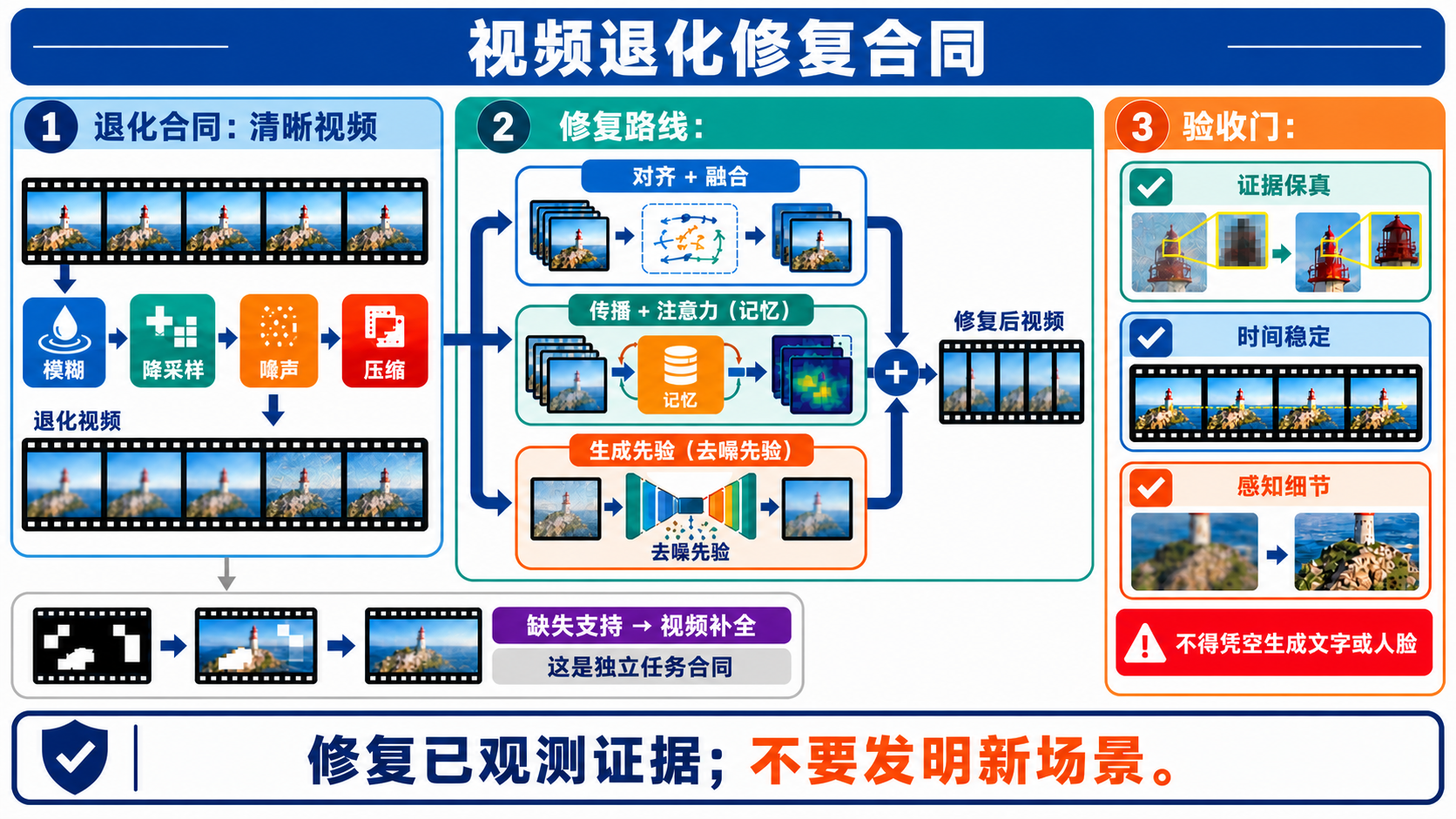
8.1 Learning objective
Show in one scan that:
- full-frame degradation restoration starts from observed but corrupted evidence;
- alignment/fusion, propagation/attention and generative priors are alternative or composable routes;
- fidelity, temporal stability and perceptual detail are independent gates;
- missing support enters a separate inpainting contract.
8.2 Built-in image generation prompt
The project used the built-in image generation path with the scientific-educational use case. Required verbatim labels included VIDEO RESTORATION CONTRACT, DEGRADATION CONTRACT, RESTORATION ROUTES, ACCEPTANCE GATES, BLUR, DOWNSAMPLE, NOISE, COMPRESSION, ALIGN + FUSE, PROPAGATE + ATTEND, GENERATIVE PRIOR, EVIDENCE FIDELITY, TEMPORAL STABILITY, PERCEPTUAL DETAIL, MISSING SUPPORT → INPAINTING, SEPARATE TASK CONTRACT, and RESTORE OBSERVED EVIDENCE; DO NOT INVENT A NEW SCENE.
The first output contained transparent regions that rendered as black in dark contexts. A targeted image edit changed only the background/transparent regions to solid white while preserving all labels and layout. The first generated file was not retained as the project asset; the corrected opaque file was copied into the repository.
8.3 Asset checks
At integration time:
pixel size: 1672 x 941
format: PNG
alpha: no
SHA-256: bd2842ad8150ff276d6eabc1af609fe8f928f117c5d8632dc8a9025ad42f45c0
The chapter also includes an accessible Mermaid alternative and a sequential text alternative. The raster is explanatory, not a benchmark plot; it contains no fabricated scores or rankings.
9. Integration checklist
- add the dedicated task chapter;
- split taxonomy rows for degradation restoration and masked completion;
- correct V2V routing and decision tree;
- add an explicit adjacent-task note to inpainting;
- link restoration metrics in evaluation;
- update README task map/tree and learner path;
- add the chapter to the coverage audit and visual queue;
- update timeline/reading route with only the milestones needed to expose the technical transition;
- run citation-anchor, relative-link, markdownlint, Mermaid and image checks.
9.1 Verification result
Checks were run after the chapter, task-boundary corrections, navigation, timeline and course-route integration:
| Check | Result |
|---|---|
| Markdown | markdownlint-cli2 0.23.2 / markdownlint 0.41.1: 15 changed/new docs and logs, 0 issues; README retains two pre-existing warnings outside the changed lines |
| Reference closure | Restoration chapter: 30 reference anchors, 56 citation occurrences, 30 unique cited references; no missing, orphan, duplicate or numbering gap |
| Primary-source URLs | All 30 chapter reference URLs returned HTTP 200 during the final link audit |
| Local links and images | 306 relative targets checked across 16 changed/new Markdown files; 0 missing |
| Mermaid | 23 blocks across 13 changed documentation pages; all contain accTitle and accDescr, and all rendered with Mermaid CLI 11.16.0 plus system Chrome to non-empty SVG artifacts |
| Mermaid visual check | The six-branch reading route, shared falsification loop, R1–R4 reasoning scale, two WM diagrams and both restoration diagrams were inspected individually or in a contact sheet; no clipped terminal node or broken branch was found |
| Generated PNG | 1672×941 opaque sRGB PNG; original and grayscale views inspected; all required labels are correct and legible; SHA-256 matches the value above |
| Timeline media preservation | All 75 pre-existing timeline images still have non-empty alt text; the current count matches HEAD |
| Patch hygiene | git diff --check returned no error; changed-file credential-pattern scan found no candidate secret |
Temporary Mermaid and grayscale audit artifacts remained outside the repository. These checks validate documentation structure, not the cited model checkpoints.
10. Evidence limit
This integration is a primary-source literature and documentation audit. It does not independently train or reproduce the cited large restoration models. Proceedings pages verify titles, venues and author-reported mechanisms; they do not convert speed, visual quality, robustness or hallucination claims into independent results. The chapter therefore labels author protocols, formal publication status and required falsifiers separately.